The commodification of whales and the whaling economy
The WhaleThe commodification of whales and the whaling economy describe a system that turned whale bodies into energy, materials, food, and fortunes, linking distant hunting grounds to ships, factories, ports, and consumers. The book follows the value extracted at each stage while keeping its costs in view: laborers lived within the industrial process, coastal communities were shaped by its wealth, and whale populations were diminished by the demand that sustained it.
From the ship to the market
The whaling ship was at once workplace, transport, and instrument of production. In the hold of the Morgan, barrels of oil marked success in a way the crew could see: more cargo meant more profit for owners and a larger share for sailors, while each barrel still to be filled implied work yet to come. The vessel’s wooden ribs enclosed a commercial space whose diminishing emptiness measured the conversion of a living animal into saleable stock. Even the ship’s timbers retained traces of the oil they carried, so that the vessel itself came to resemble a repository of the industry it served.
The work ran on a tightly controlled rhythm. Crews stood four hours on and four hours off, while the ship’s time stretched through uneventful searching and accelerated when a whale was sighted. Recruitment, provisioning, pursuit, and capture all led toward the same end: filling barrels that could secure only a temporary return to land before another voyage. The book presents this as a cycle in which workers’ livelihoods and aspirations were tethered to the hunt, not merely as a series of isolated acts of capture.
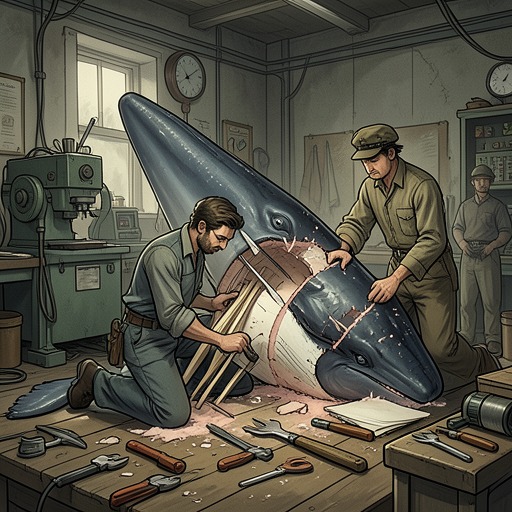
After a whale was brought alongside, the crew cut away its blubber and reduced it into portions for processing. Thin slices, called bible leaves, were placed in cast-iron try-pots set over brick ovens. The whale’s head contained a separate high-value product: spermaceti, collected from its chambers. The account stresses both the labor and the division of value in this process. Work moved between deck, blubber room, and try-pots, while the resulting materials entered a commercial chain whose returns reached beyond the ship. The animal became cargo through successive acts of cutting, sorting, heating, and storage.
Ports, factories, and unequal returns
The wealth generated at sea became visible ashore. The book describes New Bedford of Whaling's Decline and Whale-Oil Industry Debates as a port whose grand houses and gardens were financed by whales taken from the Atlantic, Pacific, and Indian oceans. Its mansions represented not a separate world from the waterfront but the final destination of its profits: each architectural luxury had an oceanic cost. The city’s prosperity was also built through work done by a diverse maritime population. By the second quarter of the nineteenth century, one in twenty residents was Black; African, Indigenous, Azorean, and Cape Verdean workers contributed to an industry whose heroes were often men of color.
Employment at sea could offer opportunities that were scarce elsewhere. Shipowners sometimes hired Black sailors without asking questions, and some workers became captains or mates. Lewis Temple, a New Bedford inventor, developed the hinged toggle-iron harpoon. Yet opportunity did not erase discrimination: bunks remained segregated, and conditions aboard ship were severe. By the end of the century, the account says, men of color were among the workers still willing to sign on. The trade’s labor system thus distributed its risks and rewards unevenly, even as the fortunes it produced became part of a port’s civic landscape.
Processing also extended into specialized manufacturing. In 1748 Jacob Rodriques Rivera introduced to New England a method for making candles from sperm-whale headmatter. The material was heated in large kettles, stored in casks, and allowed to cool; it was then pressed in woollen bags to extract spermaceti. The purest first pressing was called winter-strained sperm. The remaining matter became black cakes, which were stored until spring and pressed again for spring-strained oil. A final residue was heated with wood shavings and potash to make white wax. Each stage separated a further usable product from the same raw material, and the candle trade brought substantial fortunes to Nantucket.
Whales yielded materials beyond oil and wax. Long baleen could be heated and shaped into umbrella ribs, corset stays, and venetian blinds, or used as brush bristles. The book compares its industrial role to that of plastic: a pliable substance made useful across everyday goods. Its account of Hull likewise connects whales to a varied manufacturing economy, where whale oil was processed and baleen made into household and agricultural products. In these commodity chains, the animal’s anatomy determined what could be sold, and the range of uses helped make continued hunting profitable.
Industrial scale and changing uses
The postwar trade shows the system operating at a larger scale. In 1948 the factory ship Balaena returned to Southampton with a catch of three thousand whales. Its cargo included 4,500 tons of meat, 163,000 barrels of edible oil intended for margarine, 10,000 barrels of sperm oil, 170 tons of meat extract, and a further 3,000 tons of meat for cattle fodder. Laboratories, a blacksmith’s shop, and a hospital were aboard the ship, which stood at the docks alongside ocean liners. Whales were now accounted for not only as sources of fuel and industrial material but also as contributions to food supply and national economic recovery.
A Japanese expedition to the Antarctic in the same year reveals the scale and reach of the modern operation. It carried 1,300 men in a fleet including six catchers, the 10,000-ton factory ship Hashidate Maru, two processing ships, an oil tanker, and two cold-storage vessels. The account describes a blue whale processed as an industrial load: its parts were weighed, its blubber reduced to oil, and its meat prepared for use. One animal yielded 133 barrels of oil and sixty tons of meat valued at $28,000. The processing system sought to waste nothing, even extracting vitamin-rich oil from the liver. Yet the distant setting also exposed its human costs: wounded men could die without access to a hospital on shore.
This expansion placed commercial use beside scientific observation. Biologists studied dead whales to learn about living ones, while regulations against taking mothers with calves coexisted with the killing of pregnant animals. The book emphasizes this contradiction: the same machinery that made whales legible as measured bodies and useful products made the hunt more efficient, without ensuring that knowledge would protect them.
Extraction, depletion, and the limits of value
The economics of whaling depended on traits that made particular species easy to exploit. North Atlantic right whales carried abundant blubber, floated after death, and tended to remain near shore. Their long baleen could be fashioned into widely used goods. Those features made them profitable targets, and the book relates their commercial history to the present danger they face: fewer than four hundred remain in the North Atlantic. Protection from hunting began in 1935, but ship strikes and entanglement in fishing gear continued to threaten them. Regulations moving shipping lanes and requiring vessels to keep their distance have not reversed the population’s precarious condition; only eight matrilineal lines remain in the northern population.
Commercial extraction also removed more than individual animals. Studies discussed in the book suggest that whaling disrupted cetacean societies and could destroy cultural knowledge passed between generations, including knowledge of habitats and feeding grounds. The sperm whale population grows at only about one per cent a year, making recovery slow. The account places these effects within a wider loss of animal life: during the writing of the book, the Yangtze River dolphin was declared extinct, while the future of other whale populations remained uncertain.
The economy’s central transformation—from whale to commodity—therefore carries a lasting contradiction. Oil, wax, baleen, meat, and manufactured goods can be counted, transported, and sold; the life and social knowledge removed from the sea resist that accounting. The book traces how the same methods once used to hunt whales can be turned toward rescue, and how commercial histories continue to shape conservation needs. Its measure of the trade is not only the wealth it produced, but the depleted populations and altered human and animal lives left in its wake.